Garage Door Troubleshooting: What to Do When a Door Will Not Reverse
A garage door that will not reverse is not a minor inconvenience. It is a safety failure.
When an automatic residential garage door closes onto an obstruction and keeps pushing instead of reversing, the system is no longer doing one of its most important jobs. The door may still open. The motor may still run. The remote may still work. But the safety function that protects people, pets, and property deserves immediate attention.
The U.S. Consumer Product Safety Commission has warned for years that non-reversing garage door openers are a hazard. Automatic residential garage door openers are covered by a mandatory federal safety standard, and they must include entrapment protection. In practical terms, that usually means photoelectric “electric eye” garage door sensors or an equivalent safety system. These safety features are not accessories. They are part of what makes a garage door opener acceptable for residential use.
If your door will not reverse, stop using it as an automatic door until the problem is identified. Keep children away from the door and controls. Do not treat the opener as “mostly working.” A door that closes but fails its reversal function has crossed into garage door safety territory, and that calls for deliberate garage door troubleshooting rather than guesswork.
What “will not reverse” really means
A properly functioning garage door opener should reverse when the closing door encounters an obstruction. It should also respond correctly to its entrapment protection system, such as photoelectric sensors near the doorway. When people say a door “will not reverse,” they may be describing one of several situations.
Sometimes the door closes completely even though something is in its path. Sometimes it begins to reverse and then stops behaving consistently. Sometimes the opener ignores the sensor system. Sometimes the door seems to move with unusual force before it reacts. Each version matters because each points to a failure in a safety system, an adjustment problem, or a mechanical condition that needs inspection.
The safest starting point is simple: do not stand under the door, do not place any part of your body in its path, and do not continue operating it repeatedly “just to see what happens.” Repeated testing without a plan can turn a warning sign into an injury or additional damage.
Garage doors are heavy moving systems. Even when a door looks ordinary from the driveway, it includes a door panel assembly, opener, tracks, rollers, cables, springs, sensors, brackets, and fasteners. Many of these parts interact under load. That is why garage door repair often looks simple from a distance but becomes less forgiving once the door is moving or the opener is applying force.
The immediate safety response
The first response should be to control the hazard. If a door will not reverse, keep the opening clear and prevent casual use. That means adults in the home should know not to press the wall button or remote, and children should be told clearly not to play with the door or controls. Remote controls should be kept out of children’s reach, especially while the system is under question.
This matters because garage door problems often happen in familiar places. People become comfortable walking under a moving door because they have done it hundreds of times. Children see the door as part of the house, not as a large moving object controlled by a motor. Familiarity lowers caution, and that is exactly when a safety fault becomes dangerous.
If the door is stuck open or you need to secure the garage, use judgment. A professional garage door inspection may be the right next step, particularly if you do not know whether the door can be moved safely. Do not start loosening hardware, adjusting springs, or forcing the door by hand because the opener failed a reversal test. The reversal problem may be only one symptom of a larger mechanical issue.
A technician approaching this type of call will usually think in two broad categories. One is the opener and safety system, including the photoelectric sensors or equivalent entrapment protection. The other is the physical door system, including garage door tracks, garage door rollers, garage door cables, garage door springs, torsion springs where present, and door balance. A fault in either category can affect safe operation.
Why monthly safety testing matters
Safety systems are not “install and forget” components. The CPSC has advised that garage door opener safety reversal systems should be tested monthly. That monthly rhythm is important because a garage door is exposed to vibration, temperature changes, dust, bumped equipment, household storage, and daily movement. A system can work properly after garage door installation and still need attention later.
Monthly testing also builds familiarity. Homeowners who test regularly know what normal operation looks and sounds like. They are more likely to notice when the door hesitates, when a sensor seems out of line, or when the opener behaves differently. That kind of early recognition can prevent a small adjustment issue from becoming a hazardous condition.
The key point is not to perform aggressive experiments. It is to confirm that the door’s safety systems are present and functioning as intended. If the door fails to reverse during a safety check, the opener should be adjusted according to the owner’s manual or inspected by a professional. That instruction is worth taking literally. Different garage door opener models have different adjustment procedures, and making random changes can mask the real problem or create a new one.
Here is a short homeowner safety check that stays within sensible limits:
That is enough for a homeowner-level check. It does not require disassembling anything, reaching near moving parts, or working at ceiling height. Those are different tasks, and they belong in a more controlled repair setting.
Photoelectric sensors and the “electric eye” system
Most homeowners recognize the small devices mounted near the bottom of the garage door opening as garage door sensors. They are commonly called electric eyes. Their purpose is to help detect an obstruction in the door’s path and signal the opener before the closing door creates an entrapment hazard.
Under the federal safety standard for automatic residential garage door openers, residential systems must include entrapment protection such as a photoelectric sensor or an equivalent safety system. That requirement exists because relying only on the opener motor or door movement is not enough. The system needs a way to recognize danger before force becomes the only signal.
When a door will not reverse, the sensor system deserves careful attention. A visible sensor does not automatically mean the safety system is working. Sensors can be present but not functioning correctly. They can be blocked by stored items, affected by dirt, knocked out of position, or otherwise prevented from doing their job. The verified safety principle is straightforward: the sensors or equivalent protection must be installed and working.
Do not bypass the sensors to make the door close. That may seem like a temporary workaround, especially when someone is late for work or trying to secure the house at night, but it defeats the entrapment protection that the system is required to have. A bypassed or ignored safety system turns an automatic convenience into an avoidable hazard.
A practical example comes up often in service conversations. A homeowner says, “The door closes if I hold the wall button down, so the opener is fine.” That statement should not end the troubleshooting. If normal automatic operation depends on a safety system, then forcing the door to close through an alternate behavior does not prove the system is safe. It may only prove that the motor can move the door.
The opener is only part of the system
Many garage door troubleshooting calls begin with the phrase “my garage door opener is broken.” Sometimes that is true. But the opener is only one part of the assembly. The opener moves and controls the door, but the door itself must be able to travel properly. If the door is binding, out of balance, poorly supported, or affected by damaged hardware, the opener may struggle or behave unpredictably.
Garage door balance is especially important. A balanced door is easier for the opener to control. A door that is not balanced correctly can place extra strain on the opener and may interfere with reliable operation. Balance issues can involve garage door springs, including torsion springs on many systems. Spring systems store energy, and they are not a safe area for casual adjustment. If balance appears suspect, professional garage door repair is usually the appropriate path.
Garage door tracks and garage door rollers also matter. A door that does not move smoothly through its tracks can create resistance. Resistance changes how the opener experiences the door. Even if the reversal problem appears to be “electrical,” a rough-moving door can complicate diagnosis. The same applies to garage door cables. Cables are part of the lifting system, and visible damage, slack, or irregular movement should be treated seriously.
This is where experience matters. A professional does not look only at the sensor lights or opener settings. A good inspection considers the whole system. The door, opener, springs, cables, rollers, tracks, sensors, and controls must work together. If one part is wrong, the safety behavior of the entire system can suffer.
When adjustment is reasonable and when it is not
The CPSC guidance is clear that if the door fails to reverse, it should be adjusted according to the owner’s manual or inspected by a professional. That leaves room for homeowner action, but only within limits.
Owner’s manuals exist because opener designs vary. Control labels, adjustment procedures, and safety test instructions are not identical across all products. If you still have the manual, use it. If you do not, the model information on the opener may help you find the correct instructions through the manufacturer. Guessing at settings is poor practice, especially when the symptom involves entrapment protection.
The word “adjusted” should not be interpreted as permission to adjust every part of the door. Adjusting opener settings is different from adjusting torsion springs. Cleaning around a sensor is different from moving structural hardware. Observing the door from a safe position is different from working above your head near the opener rail or ceiling brackets.
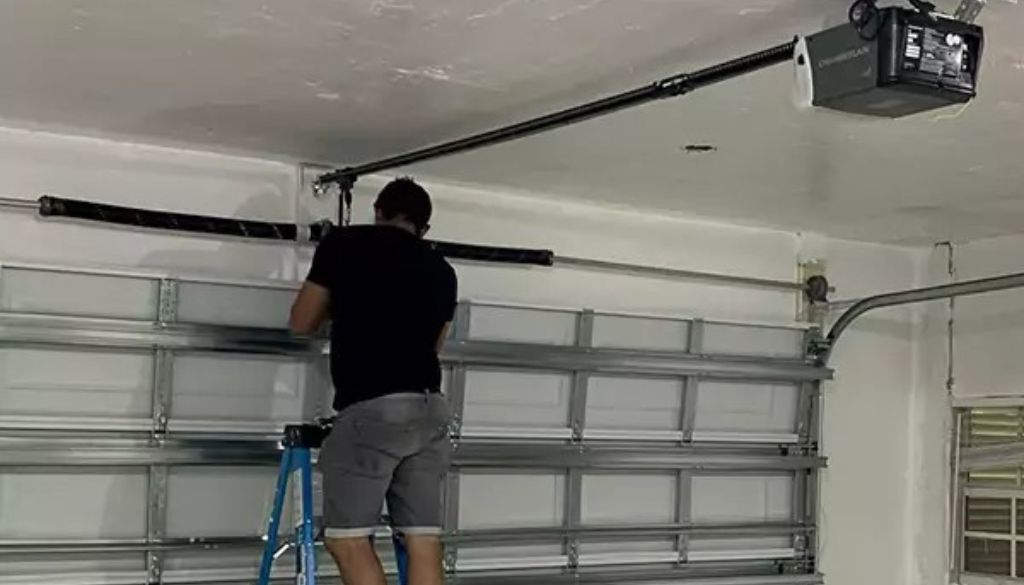
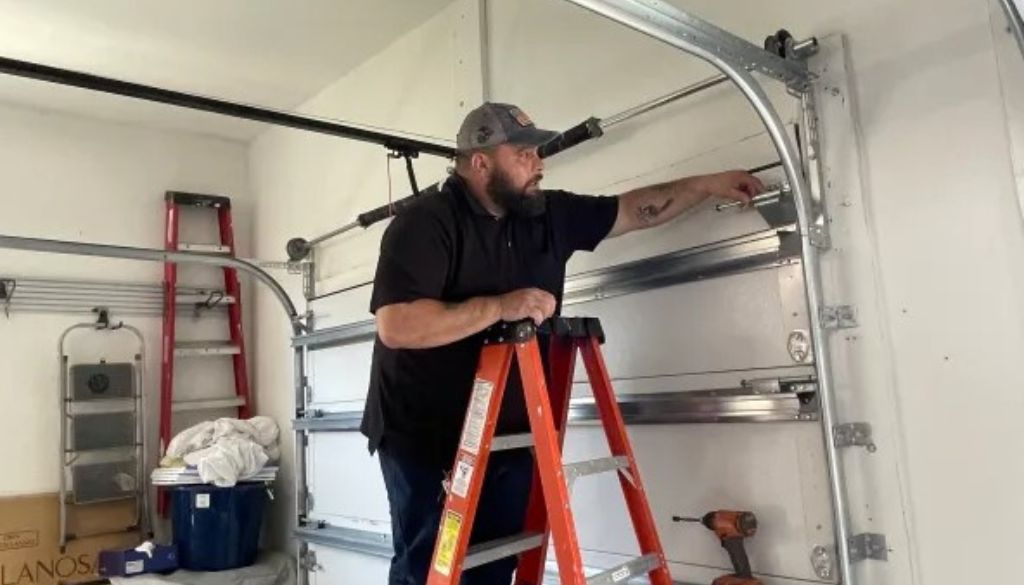
Installation and repair work around garage doors can involve physical hazards. Work may take place at ceiling height, in cramped spaces, and in awkward postures. Hand tools, ladders, overhead components, and limited visibility all add risk. Those conditions are one reason careful staging matters in garage door installation and repair. Even a capable homeowner can get into trouble when a task requires one hand on a ladder, one hand on a tool, and attention split between a moving part and overhead hardware.
A sensible rule is this: if the task requires you to loosen loaded hardware, work on springs or cables, reach into the path of movement, or operate the door while you are near the mechanism, stop and call a qualified technician. The cost of professional garage door repair is easier to justify when the alternative is working around a system designed to lift and lower a heavy door under power.
The role of garage door maintenance
Preventive garage door maintenance does not guarantee that a door will never fail a reversal test, but it improves the odds of catching problems early. Maintenance is not only about quiet operation. It is about preserving safe, predictable movement.
A homeowner-level maintenance habit can be simple. Keep the doorway clear. Pay attention to changes in sound. Look for obvious damage. Confirm that the sensors are not blocked. Schedule professional inspection when the door behaves differently or when safety testing fails. Garage door lubrication may also be part of a maintenance routine, but it should be done according to the door and opener manufacturer’s guidance rather than by spraying every visible part. More lubricant is not automatically better, and lubrication does not fix a failed safety system.
Professional maintenance goes deeper. A technician can evaluate the condition of garage door rollers, tracks, cables, springs, and the opener system. They can check whether the door is moving smoothly, whether the opener is operating within proper expectations, and whether safety systems respond correctly. If parts are worn or damaged, repair may be more appropriate than adjustment.
The best maintenance visits are not dramatic. They catch small issues before they become emergency calls. A roller that is wearing unevenly, a track problem that creates drag, or a door balance issue that makes the opener work too hard may not feel urgent at first. But these conditions can affect the reliability of the whole system, including the way the opener reacts during closing.
Older openers deserve closer scrutiny
A residential automatic opener must have entrapment protection under the federal standard, but not every opener in service is new. Homes change owners. Garages get remodeled. Openers remain in place for years. A homeowner may not know the age, installation history, or service history of the system.
If an opener lacks photoelectric sensors or equivalent entrapment protection, that is a serious concern. If sensors are present but not working, that is also a concern. If the door does not reverse properly, the age of the system should become part of the decision-making process. Repair may be possible, but garage door replacement or opener replacement may be the safer long-term answer when the system cannot be made to meet expected safety performance.
This is not about selling new equipment whenever something goes wrong. Many problems can be corrected with proper adjustment, repair, or maintenance. But there is a point where repeated failures, missing safety features, or poor system condition make replacement more reasonable than another short-term fix. A garage door opener that cannot reliably support entrapment protection is not just outdated. It is failing a core safety responsibility.
The same judgment applies to the door itself. If the opener is modern but the door hardware is in poor condition, replacing only the opener may not solve the problem. If the door is in good condition but the opener safety system is unreliable, the opener may be the focus. A careful inspection separates those possibilities.
Common mistakes that make a non-reversing door more dangerous
Most garage door hazards become worse when people try to outsmart the system. The intention is usually practical. Someone wants the car out, wants the door closed before leaving, or wants to avoid a service call. But garage door safety systems are designed around predictable operation, and shortcuts remove that predictability.
The most common mistake is continuing to use the opener after a failed reversal test. The door may seem fine when the opening is empty, but the failure only matters when something or someone is in the way. Another mistake is treating sensor problems as nuisances rather than safety faults. A blinking sensor, an intermittent close, or a door that reverses unexpectedly can feel annoying, but those symptoms often deserve attention before someone tries to override them.
Another unsafe habit is allowing children to operate or play near the door. Children should be taught garage door safety, and remote controls should be kept out of their reach. This is especially important when the system is not reversing properly. A remote control in a child’s hand can activate a door when an adult is not watching the opening.
Homeowners also sometimes confuse quiet operation with safe operation. A door can sound normal and still fail its reversal function. A freshly lubricated door can still have sensor trouble. A strong opener can still be unsafe if the entrapment protection is not working. Safety testing and inspection are different from simply noticing whether the door sounds acceptable.
The final mistake is attempting advanced repair in unsafe working conditions. Garage door repair and installation can require work at ceiling height and in tight spaces. Awkward posture and hand tools add risk, particularly when the person doing the work is unfamiliar with the system. A repair that seems easy in a video can be much less controlled in a real garage with poor lighting, stored items, and a door that may move unexpectedly.
A practical decision guide
A non-reversing garage door does not always require the same response, but it always requires a safety-first response. The decision should be based on what you can confirm without exposing yourself to danger and what the owner’s manual allows you to adjust.
| What you observe | Sensible response | |---|---| | Door fails to reverse during a safety check | Stop automatic use and follow the owner’s manual or call a professional | | Sensors or equivalent protection appear blocked | Clear the area safely, then retest only according to proper safety guidance | | Sensors are missing, damaged, or not working | Arrange professional inspection before relying on the opener | | Door movement seems rough, uneven, or strained | Have the door system inspected, including tracks, rollers, cables, springs, and balance | | The opener is old, unreliable, or repeatedly failing safety checks | Discuss repair versus garage door opener or garage door replacement options |
This kind of decision-making prevents two extremes. One extreme is panic, assuming every failed check means the whole system must be replaced. The other is complacency, assuming the door is fine because it still closes. The professional middle ground is to treat a failed reversal as a real safety defect, then identify whether adjustment, repair, maintenance, or replacement is appropriate.
What a professional inspection should focus on
When you call for garage door repair because the door will not reverse, describe the symptom clearly. Say that the door failed to reverse, not just that “the opener acts weird.” Mention whether the issue happened during a safety test or during regular use. If you noticed anything about the sensors, door movement, or unusual sounds, share that too. Good information helps the technician approach the inspection safely.
A proper garage door inspection should not stop at pressing the remote. The technician should evaluate the entrapment protection system, the opener behavior, and the physical condition of the door. They should confirm that the required safety features are present and working. They should look at movement through the tracks, the condition of rollers and cables, and whether the door appears balanced. Where springs are involved, especially torsion springs, the work should be handled with the correct tools, training, and caution.
It is also reasonable to ask what was found and why a repair is being recommended. A professional should be able to explain the difference between an opener adjustment, a sensor correction, a hardware repair, and a replacement recommendation. You do not need a lecture, but you should understand whether the repair addresses the actual safety failure.
If the technician recommends replacement, ask whether the recommendation is driven by missing safety protection, repeated failure, condition of the opener, condition of the door, or a combination of factors. Garage door replacement is a larger investment than repair, and it should be connected to the condition and safety performance of the system, not offered as the only answer to every problem.
Why this is not a good place to gamble
The history behind garage door opener safety rules is not theoretical. Fatal entrapment incidents involving automatic garage doors have been documented, which is why safety reversal systems and entrapment protection matter. The purpose of these systems is to reduce the chance that a closing door traps or injures someone in its path.
That context changes how a homeowner should view a failed reversal test. It is not the same as a burned-out light in the opener or a noisy hinge. It directly involves the system’s ability to respond to an obstruction. Even if your household has no small children, the door may be used by visitors, neighbors, delivery workers, pets, or future occupants. Safety features protect more than the person who owns the remote.
A garage door is one of the largest moving systems in many homes. It operates in a space where people carry groceries, guide children, move bicycles, store tools, and back vehicles in and out. Because the door is familiar, it rarely gets the respect given to other powered equipment. A failed reversal test is a reminder to slow down and treat the system with appropriate caution.
Living with the door after repair
Once the problem is corrected, do not let the experience disappear from memory. Add monthly safety testing to your normal home routine. Pair it with something you already do monthly, such as replacing an HVAC filter, checking smoke alarms, or reviewing household maintenance tasks. The exact pairing matters less than the consistency.
Pay attention to changes between tests. A door that starts to sound strained, move unevenly, or behave inconsistently should be inspected before it fails completely. Keep the sensor area clear. Store items where they cannot block the safety system. Make sure children understand that the garage door is not a toy and that remotes are not playthings.
If you have recently had garage door installation, opener replacement, or significant repair work, take time to understand the new equipment. Know where the owner’s manual is. Learn what normal operation looks like. Ask the installer how to perform routine safety checks in a way that matches that opener. A new system still needs maintenance and testing.
Good garage door maintenance is not complicated, but it is disciplined. It respects the difference between observation and repair. It keeps safety systems in view. It treats garage door lubrication, visual checks, and professional service as parts of a larger safety habit rather than isolated chores.
The safest next step
When a garage door will not reverse, the correct response is not to keep trying until it behaves. Stop automatic use, keep the opening clear, keep controls away from children, and treat the failure as a safety issue. Check only what you can check safely, such broken garage door repairs Gold Coast as whether the sensor path is clearly blocked. Then use the owner’s manual for approved adjustment or schedule a professional inspection.
A reliable garage door opener should do more than move the door. It should help protect against entrapment. The sensors or equivalent safety system should be installed and working. The door should travel smoothly, with the tracks, rollers, cables, springs, and balance in suitable condition. If any part of that chain fails, the whole system deserves attention.
Repair, maintenance, adjustment, and replacement each have their place. The right choice depends on the condition of the opener, the safety system, and the door itself. What should never be optional is the reversal function. If the door will not reverse, do not ignore it, do not bypass it, and do not let everyday convenience outrank garage door safety.